
Business Casual for Tech Company: The 2027 Guide
Quick answer
Business casual for tech company is the most relaxed version of the code, and this guide is part of our what is business casual guide. In a tech company, dark jeans, clean sneakers, and a polo pass every day, and a blazer is optional. In a finance office, the same outfit fails, and the code is a suit without a tie, a shirt, trousers, and leather shoes. The difference is not the shirt. It is the formality, and it is the whole story of this article. The table below gives the verdict for each office type, piece by piece.
The four office types

Business casual is not one code. It is four codes, one for each office type, and the pillar’s own formality labels are the fastest way to remember them. Dressy casual is the strictest, business casual is the middle, and less dressy is the loosest. The same item can pass one and fail another, and the office type is what decides it.
| Office type | Formality label | The code in one line |
|---|---|---|
| Finance or Law | Dressy casual | Suit without a tie, shirt, trousers, leather shoes |
| Corporate | Business casual | Shirt, chinos or trousers, loafers, blazer optional |
| Tech or Startup | Less dressy | Polo, dark jeans, clean sneakers, blazer optional |
| Creative or Agency | Less dressy | Polo or knit, dark jeans, clean sneakers, blazer optional |
The labels matter because they are the pillar’s own words, and they are the words the site uses everywhere else. Dressy casual means the suit is still in the room, even without the tie. Business casual means the suit is gone, but the shirt and the trousers are still there. Less dressy means the jeans and the sneakers are in the room, but the hoodie and the shorts are not.
Business casual for tech company
Business casual for tech company is the most relaxed version of the code, and it is the one most people mean when they say “business casual” and picture a relaxed office. In a tech company, dark jeans pass every day, clean sneakers pass every day, and a polo passes every day. A blazer is optional, and it is the piece that moves the outfit from a desk day to a meeting day.
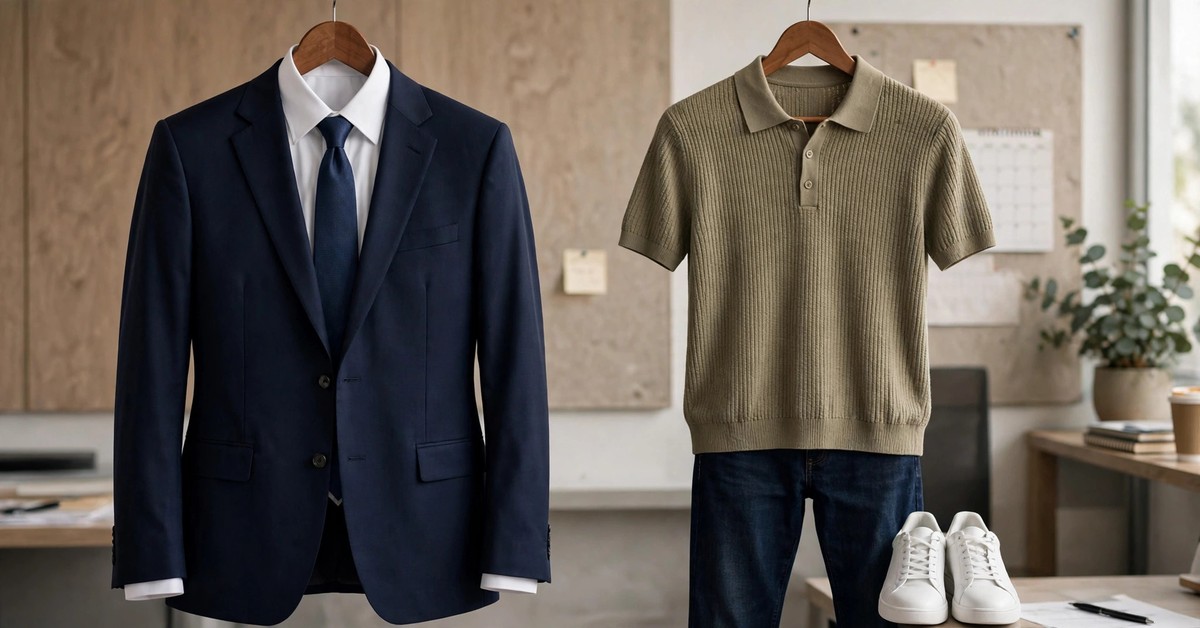
The standard tech outfit is simple: a navy or white knit polo, dark indigo jeans, clean white leather sneakers, and a navy blazer carried not worn. The polo is the shirt, the jeans are the casual element, and the blazer is the formality. One casual element is the limit, and the jeans are it.
The pieces that still fail in a tech company are the ones that fail everywhere: shorts, hoodies, flip flops, gym clothes, and graphic T-shirts. A tech office is relaxed about jeans and sneakers, not about the whole list. The offices that allow more say so in writing, and they still ban the rest.
The shoes are the clearest tell. Clean leather sneakers in white, black, or grey, with no visible logo, pass in a tech company. Running shoes do not, however clean they are. The difference is the shape: a leather sneaker is a shoe, a running shoe is a trainer, and the office treats them differently.
Business casual for finance
Business casual for finance is the strictest version of the code, and it is the one most people mean when they say “business casual” and picture a bank. In a finance office, jeans fail, sneakers fail, and a polo is an only if, not a yes. The code is a suit without a tie, a shirt, trousers, and leather shoes, and the suit is still in the room, even without the tie.
The standard finance outfit is simple: a charcoal or navy suit, worn without the tie, with a white or light blue shirt, a leather belt, and black oxford shoes. The suit is the formality, the shirt is the collar, and the shoes are the office. Our shoes guide lists oxford shoes at about $99 to $150, which is the range to expect for a good leather pair.
The history matters here. In March 2019, Goldman Sachs sent a memo from CEO David Solomon to about 36,000 employees, moving the firm to a flexible dress code and telling staff to dress to match client expectations. That is the most famous relaxation in finance. The memo named no specific items, but the understood change was a suit without a tie, not jeans or sneakers at the desk. The relaxation was one step, not ten.
The finance rule is the client rule, applied every day. In finance, the client is always in the room, even when they are not, and the outfit has to pass for a client who has never met you. That is why the code is stricter, and why it stays stricter even after the memo.
The matrix: every item, every office
The table below is the whole article in one place. Find the item, find the office, and the verdict is there.
| Item | Finance or Law | Corporate | Tech or Startup | Creative or Agency |
|---|---|---|---|---|
| Dark jeans | No | Only if | Yes | Yes |
| Ripped jeans | No | No | No | No |
| Clean sneakers | No | Only if | Yes | Yes |
| Running shoes | No | No | No | No |
| Polo shirt | Only if | Yes | Yes | Yes |
| T-shirt under blazer | No | Only if | Only if | Only if |
| Hoodie | No | No | Only if | Only if |
| Shorts | No | No | No | Only if |
| Sleeveless top alone | No | No | Only if | Only if |
| Sleeveless top with blazer | Yes | Yes | Yes | Yes |
| Leggings as pants | No | No | No | No |
| Flip flops | No | No | No | No |
| Blazer | Yes | Yes | Yes | Yes |
| Suit without tie | Yes | Yes | Yes | Yes |
| Loafers | Yes | Yes | Yes | Yes |
The pattern is clear. The blazer, the suit without a tie, and the loafers pass everywhere. The leggings, the flip flops, and the ripped jeans fail everywhere. Everything else moves, and the office type is what moves it. The jeans and the sneakers are the pieces that change most, and they are the pieces people get wrong most often.
The most useful row is the polo. A polo is an only if in finance, and a yes everywhere else. That one row tells you the whole story: the polo is the shirt that moves, and the office is what moves it. In finance, the polo is a relaxed day shirt. In corporate, tech, and creative offices, it is a normal shirt.
How to dress for each office
The outfits below are the standard for each office type, and they are the ones to copy when you start a new job. They pass on the first week, and they pass on a client day, because they are built on the strictest version of each code.
Finance or Law, men: charcoal suit without a tie, white shirt, black leather belt, black oxford shoes. The suit is the formality, the shirt is the collar, and the shoes are the office.
Finance or Law, women: navy suit without a tie, white blouse, black tailored trousers, black leather loafers or low block heels. The suit is the formality, the blouse is the collar, and the shoes are the office.
Corporate, men: white button down shirt, navy chinos, brown leather belt, brown leather loafers. Add a navy blazer for meetings. The shirt is the formality, the chinos are the comfort, and the loafers are the office.
Corporate, women: white short sleeve blouse, black tailored trousers, black leather loafers. A simple necklace, nothing that jangles. The blouse is the formality, the trousers are the office.
Tech or Startup, men: navy knit polo, dark indigo jeans, clean white leather sneakers, navy blazer carried not worn. The polo is the shirt, the jeans are the casual element, and the blazer is the formality.
Tech or Startup, women: black fine knit top, dark jeans, clean white sneakers, camel blazer. The knit is the casual element, the jeans are the casual element, and the blazer is the sharp piece.
Our capsule system makes 20 outfits from 10 pieces for $412, and it is built on the corporate code, which is the middle of the four. That is the system to copy when you want a wardrobe that passes in every office: swap the chinos for dark jeans and the loafers for clean sneakers, and the outfit moves to tech. Swap the chinos for suit trousers and add a tie, and the outfit moves to finance.
Check your outfit first
If you are still unsure, run the outfit through our business casual dress code checker before you leave the house. It asks five quick questions, gives a yes, only if, or no, plus a fix and an outfit, and takes about a minute. No email needed.
Frequently Asked Questions
What is business casual for a tech company?
Business casual for tech company is the most relaxed version of the code: dark jeans, clean sneakers, and a polo pass every day, and a blazer is optional. Shorts, hoodies, flip flops, and gym clothes still fail.
What is business casual for finance?
Business casual for finance is the strictest version of the code: a suit without a tie, a shirt, trousers, and leather shoes. Jeans fail, sneakers fail, and a polo is an only if, not a yes. The client is always in the room, even when they are not.
Can you wear jeans in a finance office?
No. Jeans fail in finance and law, even dark jeans, even on casual Friday, unless the written policy explicitly allows them. The Goldman Sachs memo of March 2019 moved the firm to a flexible dress code, and the understood change was a suit without a tie, not jeans.
Can you wear sneakers in a tech company?
Yes, if they are clean leather sneakers in white, black, or grey, with no visible logo. Running shoes do not pass, however clean they are. The difference is the shape: a leather sneaker is a shoe, a running shoe is a trainer.
How do I know which office type I am in?
Read the handbook, and watch the room on the first week. The handbook names the code, and the room shows you the unwritten code. Dress one notch up for the first week, and learn the room before you test the relaxed code.
What is tech casual dress code?
Tech casual dress code is the most relaxed version of business casual, the code most tech and startup offices use. A polo or knit top, dark jeans, and clean leather sneakers pass every day, and a blazer is optional. Shorts, hoodies, flip flops, and gym clothes still fail, even in a tech office.
The Bottom Line
Business casual for tech company is the most relaxed version of the code, and business casual for finance is the strictest. The difference is not the shirt. It is the formality. The blazer, the suit without a tie, and the loafers pass everywhere. The jeans and the sneakers are the pieces that move, and the office type is what moves them.
Sources and further reading
- Goldman Sachs flexible dress code memo (https://www.wealthmanagement.com/wealth-management-industry-trends/suits-and-ties-now-optional-goldman-sachs-hedges-dress-code)
- Charles Tyrwhitt business casual guide (https://www.charlestyrwhitt.com/us/how-to-dress-business-casual.html?cm_sp=TN-how-to-dress-business-casual)
- SHRM summer dress code guidance (https://www.shrm.org/topics-tools/employment-law-compliance/not-to-wear-summer-work)
Related guides
Business Casual Dress Code for Women: 2027 Guide
Business Casual Dress Code for Men: The 2027 Guide