

What Is Business Casual? The Simple Guide for Work
Quick answer
What is business casual? It is a work dress code that sits between a full suit and weekend clothes. It usually means slacks, khakis, or a skirt with a dress shirt, blouse, or polo. A blazer is optional. A tie is not needed. Shoes should be clean and closed toe. The exact rules change with your office, so always check what your own workplace expects.
What Does Business Casual Mean?
Business casual is a dress code, not a single outfit. It tells you to look neat and professional without wearing a full suit and tie.
The Emily Post Institute gives the clearest definition. It says casual business attire generally means slacks, khakis, or a skirt with a dress shirt, blouse, or polo. Dresses and seasonal sport coats fall into this dress code as well.
That definition is a good start. But it leaves out the part that confuses most people. Business casual does not look the same in every office. A law firm and a tech startup can both say “business casual” and mean two different things.
So think of business casual as a range, not a fixed list. The range runs from “almost a suit” to “a polo and chinos.” Your office decides where you sit on that range.
The Oxford Dictionary describes business casual as clothing “intended to give a professional and businesslike impression.” That is the test to use. If your outfit gives a professional impression, you are close. If it looks like weekend clothes, you are not.
The One Rule That Explains Everything
Here is the rule that makes business casual simple. Dress one notch down from what your office usually wears.
Emily Post explains it the same way. What is acceptable is about one notch down the formality chain from the usual expectations. So you need to know what is usual in your workplace first.
That gives the code two versions.
Dressy casual. This is for offices where people usually wear suits. Here business casual means a jacket, a button-down dress shirt with the tie optional, slacks, and loafers. You drop the tie and the matching suit. You keep the rest.
Less dressy. This is for offices where people do not usually wear suits. Here business casual means an optional sweater, a button-down shirt, chinos or khakis, and casual leather shoes or well kept sneakers. You drop the jacket. You keep the clean, neat look.
The term itself is not new. Business casual started to spread in American offices in the late 1980s and 1990s, when tech companies moved away from suits. In 1992, Levi Strauss mailed its Dockers “Guide to Casual Business Wear” to about 25,000 human
resources managers. That guide helped the idea spread across US offices.
Where Business Casual Sits on the Ladder
Dress codes form a ladder from most relaxed to most formal. Business casual sits in the middle. This table shows where it fits.
| Dress code | What it usually means | Where you see it |
|---|---|---|
| Casual | Jeans, T-shirts, sneakers, whatever is clean | Weekends, very relaxed startups |
| Smart casual | Dark jeans or chinos, a polished shirt or knit, leather sneakers or loafers | Dinners, creative workplaces, social work events |
| Business casual | Slacks or a skirt, a collared shirt or blouse, blazer optional, no tie | Most US offices |
| Business professional | A suit with a matching jacket and trousers or skirt, dress shirt, tie | Finance, law, formal meetings |
| Formal | A dark suit, white shirt, tie, polished dress shoes | Board meetings, court, black tie events |
The key point is simple. Business casual is one step below business professional and one step above smart casual. If you are not sure which side you are on, dress one step smarter. It is always safer to be slightly overdressed than underdressed.
Business casual is not the same as smart casual. Smart casual is about style and personality. Business casual is about the office. Dark jeans can be smart casual. They are only business casual in a relaxed office. Our guide to business casual vs smart casual explains the full difference in a later article.
Business Casual for Men
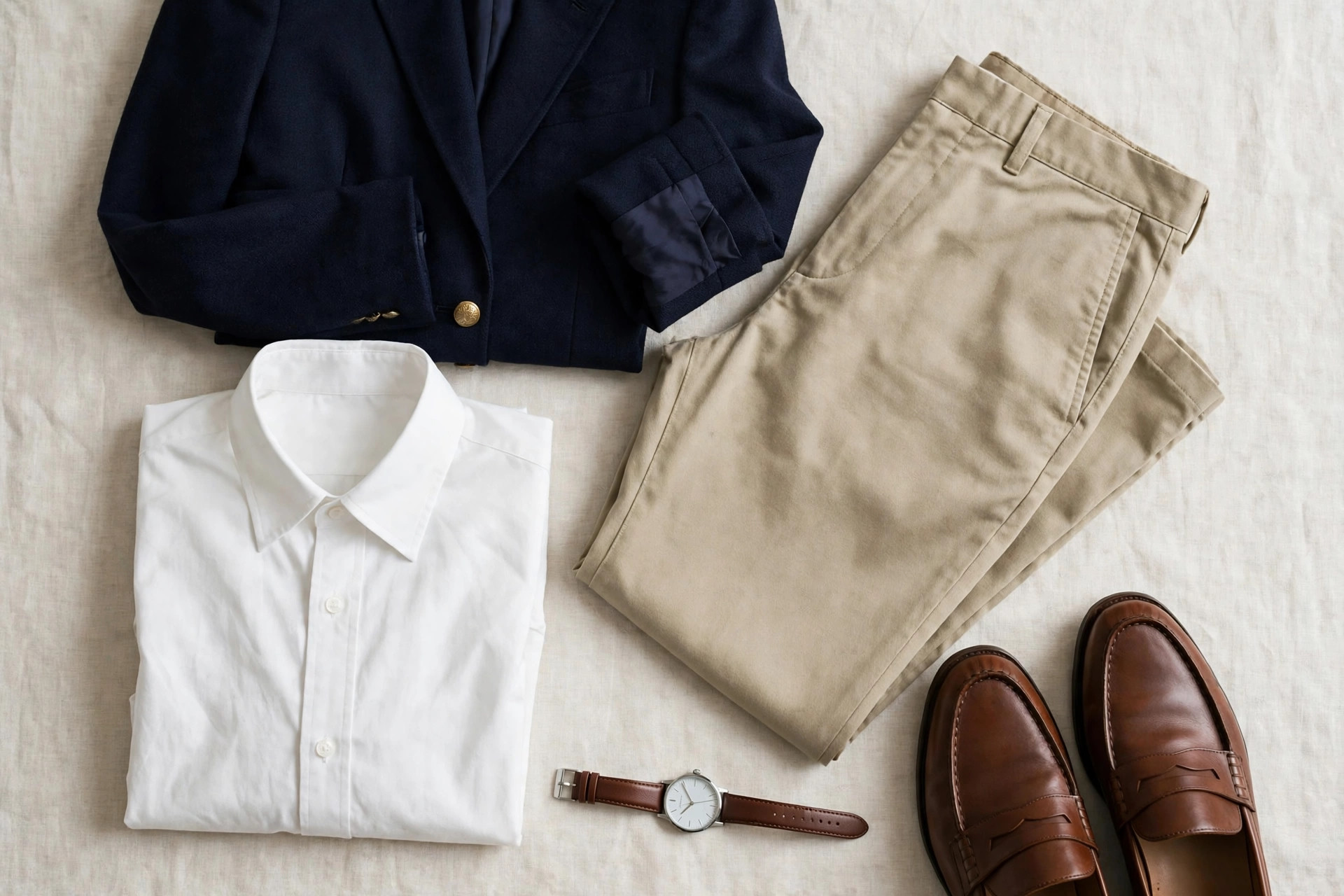
For men, business casual means swapping the full suit for smart separates. You still want to look sharp. You just get to be a little more relaxed.
What usually works:
- Chinos or wool trousers in navy, grey, khaki, or olive
- An Oxford cloth button-down shirt or a plain dress shirt
- A polo shirt in cooler months or in a relaxed office
- A blazer or sport coat, optional but always a safe choice
- Leather shoes, loafers, derbies, or clean leather sneakers where allowed
- A leather belt that matches your shoes
- Socks that cover the ankle, in a dark or neutral color
What usually does not work:
- Ripped or faded jeans, unless your office clearly allows them
- T-shirts with large logos or graphics
- Shorts, gym clothes, and hoodies
- Flip-flops and sandals
- Wrinkled or stained clothes
A go-to outfit is chinos with a collared shirt and a blazer, paired with brown leather shoes. If your workplace leans relaxed, a fine knit sweater over a shirt with tailored trousers also works well.
Business Casual for Women

For women, business casual offers more choice. That is a benefit and a small challenge. The aim is to look smart and professional while staying comfortable enough to wear all day.
What usually works:
- Blouses, smart shirts, or fine-knit tops
- Tailored trousers, chinos, or smart skirts at knee length or below
- Knee-length or midi dresses in simple, professional cuts
- A blazer or structured cardigan
- Loafers, ballet flats, low block heels, or clean leather shoes
What usually does not work:
- Spaghetti straps or a low neckline, unless covered by a blazer or cardigan
- Very short skirts or dresses
- Leggings worn as trousers
- Athletic wear, flip-flops, and beach sandals
- Sheer tops with nothing underneath
A classic outfit is tailored trousers with a blouse and a blazer, finished with loafers. A knee-length dress with a cardigan is another safe choice. Keep jewelry simple and keep the focus on a neat, finished look.
Business Casual by Office Type

This is where most guides stop. But this is the part that matters most. The same outfit can be right in one office and wrong in another. Use this table as your starting point.
| Item | Finance or Law | Corporate | Tech or Startup | Creative or Agency |
|---|---|---|---|---|
| Dark wash jeans | No | Only if, with a blazer | Yes | Yes |
| Clean leather sneakers | No | Only if, with a blazer | Yes | Yes |
| Polo shirt | Only if, knit polo plus blazer | Yes | Yes | Yes |
| Plain T-shirt under a blazer | Only if | Yes | Yes | Yes |
| Leggings as trousers | No | No | Only if, with a long tunic or blazer | Only if |
| Shorts | No | No | Only if, tailored, summer, no meeting | Only if |
| Hoodie | No | No | Only if, no meeting | Only if |
| Sleeveless top | Only if, with a blazer | Yes, with a blazer | Yes | Yes |
| Sandals | No | No | Only if, leather sandals | Only if |
Read the table from left to right. Finance and law are the strictest offices. Creative studios are the most relaxed. Corporate sits in the middle. Tech is close to creative but still a workplace.
Two things to remember. First, a client meeting or a job interview raises the bar by one level in every office. Jeans that pass on a normal desk day can fail in a client meeting. Second, your own employer policy beats any table. If your handbook says no jeans, then no jeans. Always check your HR policy first.
Our business casual by profession guide goes deeper into teachers, nurses, tech workers, and finance staff, plus summer and winter dressing.
Business casual work outfit ideas for each office type
These outfits use only the pieces that pass above. Each one shows how the same code looks in a different office.
The finance or law office day: Wear a navy blazer with a white button down shirt, gray wool trousers, brown leather loafers, and a leather belt that matches your shoes. Keep the tie at home, keep jeans and sneakers at home, and keep the blazer on for every meeting. This is the dressy casual version of the code.
The corporate office day: Wear a blouse with tailored trousers, a blazer, and loafers. Choose navy or black trousers and a plain blouse in a solid color. The blazer makes the outfit safe for a client meeting, and the loafers keep it smart for a full desk day.
The tech office desk day: Wear a knit polo with chinos and clean leather sneakers where your office allows them. Pick a plain polo in a solid color with no large logo. Add a blazer if a client meeting is on the calendar that day, and swap the sneakers for loafers if you are not sure.
The creative office day: Wear a midi dress in a simple cut with a structured cardigan and ballet flats. Keep the dress at knee length or below, keep jewelry simple, and keep the cardigan on if the top has thin straps. The look stays neat and finished without a full suit.
What Not to Wear
Some items are almost never business casual. If you are unsure, this list is your quick check.
- Ripped, faded, or distressed jeans
- Gym clothes, sweatpants, and hoodies
- T-shirts with slogans, large logos, or graphics
- Shorts and flip-flops
- Tank tops, tube tops, and spaghetti straps worn alone
- Sheer or see-through clothes
- Very short skirts or dresses
- Dirty, wrinkled, or stained clothes
- Strong perfume or cologne that fills the room
A simple test helps. If you would wear it to the gym, the beach, or a nightclub, it is probably not business casual.
How to Read Your Own Office
You do not need to guess. Four quick checks tell you what your office expects.
- Read the policy. Check your employee handbook or ask HR. Ask about jeans, sneakers, and open-toe shoes by name. Vague rules cause most dress code mistakes.
- Watch your colleagues. Look at what people wear on an ordinary Tuesday, not on a party day. Copy the level, not one person’s outfit.
- Check the photos. Look at recent company photos or social media posts. They show the real standard better than any handbook.
- Dress one level smarter on day one. For a first day or an interview, go smarter than the daily norm. You can relax later once you know the room. Our guide to what to wear to a business casual interview shows exactly how to do this.
If your office has no written policy, ask your manager. One short question saves a week of worry.
Not Sure About an Outfit? Check It in 30 Seconds
Reading a table is one thing. Checking your own outfit is faster. Our free Business Casual Dress Code Checker asks five quick questions about your office, your occasion, and your outfit. It gives a Yes, No, or Only-if answer, plus the reason and the outfit that makes it work.
Use it before an interview, a client meeting, or your first day. It takes about 30 seconds, it asks for no email, and it sends your answers nowhere.
Frequently Asked Questions
What is business casual in simple words?
Business casual is a work dress code between a full suit and weekend clothes. It usually means slacks or a skirt with a collared shirt or blouse. A blazer is optional. A tie is not needed. Shoes should be clean and closed toe.
Can you wear jeans with business casual?
It depends on your office. Dark wash jeans with no rips can work in tech and creative offices, and in corporate offices when worn with a blazer. They usually do not work in finance or law offices. For an interview or a client meeting, skip jeans and wear tailored trousers instead.
Are sneakers business casual?
Clean leather sneakers can be business casual in relaxed offices, especially tech and creative workplaces. Athletic sneakers, running shoes, and dirty trainers are not. In finance, corporate, and formal offices, wear leather shoes or loafers instead.
Is a polo shirt business casual?
Yes, in most offices. A plain knit polo in a solid color works well, especially with chinos and a blazer. Avoid polo shirts with large logos, bright patterns, or a sporty look. In a finance office, wear the polo under a blazer.
What is the difference between business casual and smart casual?
Business casual is an office dress code. Smart casual is a social dress code that allows more personal style. Dark jeans and leather sneakers are usually smart casual. They are only business casual in a relaxed office. Business casual is one step more formal than smart casual.
Do I need a tie for business casual?
No. A tie is not needed for business casual. In fact, a tie usually moves an outfit toward business professional. If you want to look smarter, add a blazer instead of a tie.
Sources and further reading
Emily Post Institute business casual guide
SHRM guide to summer dress codes at work
TheStreet business casual cheat sheet
Related guides
- What to Wear to a Business Casual Interview
- Business Casual Capsule Wardrobe: 10 Pieces, 20 Outfits, One Budget
- Business Casual by Profession: Teachers, Nurses, Tech, Finance, and More
- Best Business Casual Shoes for Men and Women in 2026
- Are Sneakers Business Casual? The Honest Answer
- Business Casual Dress Code for Men: The 2027 Guide
- Business Casual Dress Code for Women: 2027 Guide
- Business Casual vs Smart Casual: The Difference
- Can You Wear a Hoodie Business Casual? Almost Never
- Can You Wear a Polo Shirt Business Casual? Yes, If
- Can You Wear a Sleeveless Top Business Casual 2027
- Can You Wear Jeans With Business Casual? Yes, If
- Can You Wear Leggings to Work Business Casual? No
- Can You Wear Shorts to Work Business Casual? No
- Business Casual for Tech Company: The 2027 Guide
- What Not to Wear Business Casual: The Full List